
Space Between Pain and Consolation
2025 didn’t finish me off, but it won’t pass without me trying to finish it off. This is the text.

I can’t stand repetition. The joke that’s always the same, the stock phrase in a comment, the greeting that never changes. Taking the same route every day, having a fixed day to eat the same thing, traditions that no longer mean anything. My mind wasn’t made for repetition; it constantly resists the tendency to walk paths that are already known. Fortunately for me, 2025 was a year that cannot be repeated. Its brutality could even mark the inauguration of a new era—the new world they talk about out there—but I have other things to do.
At the same time, the habit of taking stock is, in itself, a way of repeating actions. On the one hand, there is the act of reviewing. We review what we did and didn’t do, what happened to us and what we would have liked to happen, with the aim of creating an interpretation that groups together events that would otherwise have little in common beyond having happened to the same person. However, I am too distracted to be a reviewer; I end up mixing everything together. On the other hand, taking stock becomes an act of reliving. Reliving what happened places us in a position of fragility and forces us to face things, which is a good thing, even if my end-of-year message is more about freeing ourselves from what weighs us down. You have to live the process.
Every assessment tends to become a story about the ending we reach. The way we feel at the end of a given period can reshape everything that was experienced within it. Is that why most versions of this text have carried traces of bitterness? That realisation has shown me the value of thinking more carefully about what is said or written, of having time. Writing like this is my way of naturalising things, of reliving them internally until I find a way to express them, perhaps without the weight of immediacy, but with the substance of what has been lived. The time spent thinking about this text brought many positive things. If I arrive here with a smile, it is one of satisfaction with the journey, however painful it may have been. And may it continue.
Ending Football
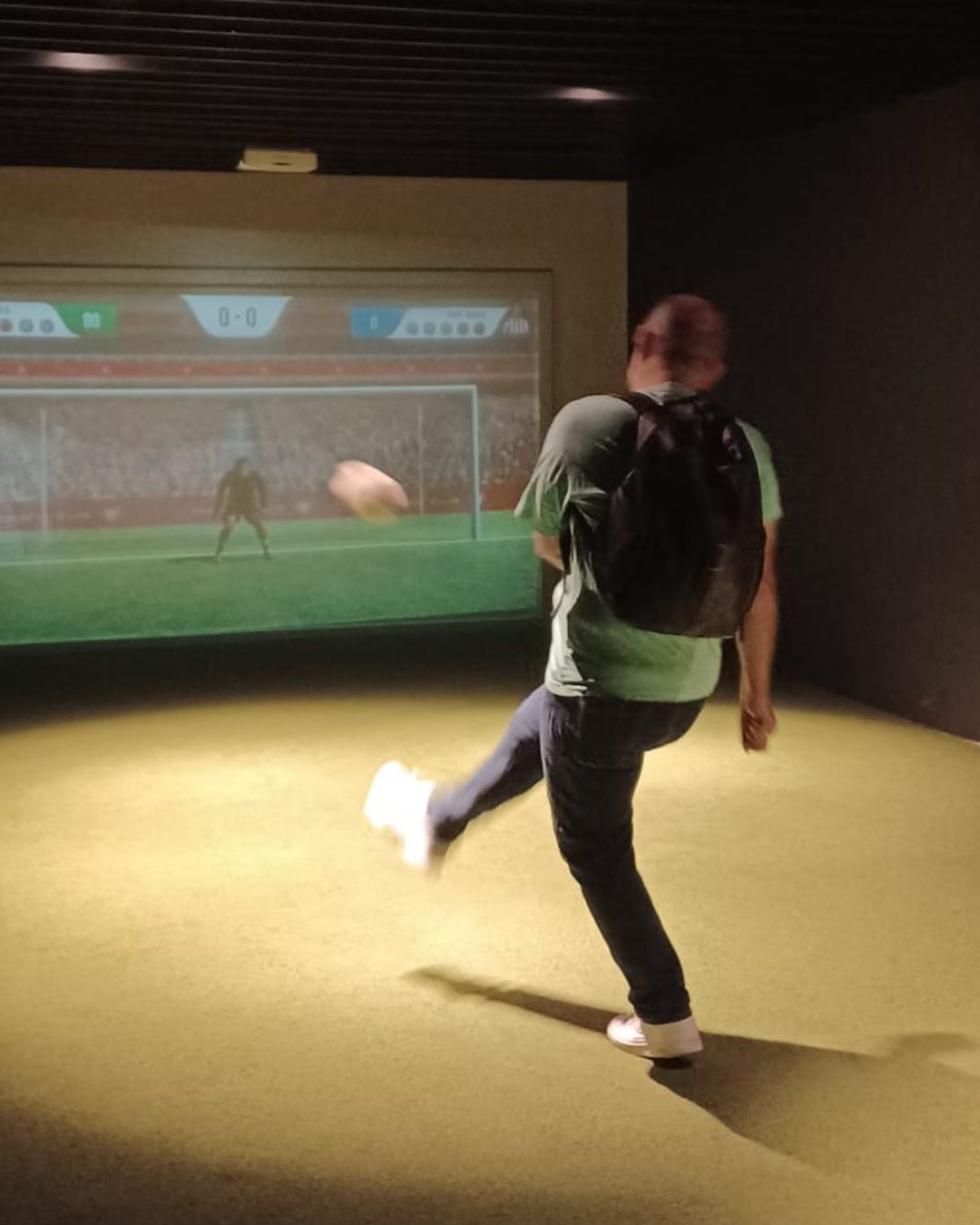
In 2025, there is little hope left for a positive change in how elite football is perceived. The eternal return to minimalism, the search for insignificant details, the constant displacement of the meager attention we still have away from the game itself, all of this results in a profound failure of football as a space of belonging and collective construction. Throughout the year, I encountered this suffocating breathlessness, which forces us to return again and again to the sterile discussion of refereeing decisions based on images that explain nothing, stripped of context, endlessly inventing conspiracies to justify individual weaknesses. This football of blaming the other is a game without interest, where the joy that once brightened our weekends has been lost.
The territory of football is also drying up, withering like a forgotten plum in the stands. The game is no longer the game of the fan, of identity, of competition; it has become a banalised version of tactical analysis, repackaged for social media—the “radio edit”—transforming a rich and revealing exploration of human dynamics, what coaches actually do, into the cold gesture of a hand moving a piece across a tabletop. This minimalism to which elite football is condemned strips it of its connection to the origins of our enchantment, despises who we were, and leaves behind nothing but raw meat to feed scavenging birds.
The Club World Cup and the path being taken toward the World Cup in North America offer further reasons for my growing distance from the game. The false idea of spectacle as a permanent temptation, built on impoverished teams, players, and ideas, until all matches feel the same, uninteresting, interchangeable, stripped of anything distinctive, wrapped in poor and repetitive language (there it is again). The convergence of figures like Donald Trump and Gianni Infantino, alongside the pervasive presence of Saudi interests in everything of scale within elite football, shapes the atmosphere and leaves us without a clear way to experience the game as we would like.
Throughout this year, faced with this feeling of suffocation, I broke down. It has become difficult for me to look at the game through the narrow services they want to confine it to. And while the constant resistance to this reality has made me consider abandoning my role as a professional critic, the truth is that it was necessary to escape the trap by transforming my spaces into something that meant more to me (and here is my apology to those who came here for football and are now taking it elsewhere).
The Two Deaths
On Christmas Day, Mr. Octávio Carapeta, the owner of Arcádia—the record store where generations of young people from Torres Vedras shaped their musical taste over decades through his kindness and generosity—passed away. This Monday, news arrived of the death of António Neto, from Serra da Vila, a friend of my father who was always so attentive and caring toward me that I say goodbye to him as one would to a grandfather.
The death of a person confronts us with a void that is soon filled with good memories. At the moment of death, a new form of communication is established with the person who is no longer here, restoring their meaning in our lives and rewriting our present through the light of what was lived with those who leave our world.
When a personal relationship fades, memory often becomes entirely bound to pain. What was lived begins to deteriorate, as if only the negative aspects could survive separation. The life of the other becomes a field of possibility from which we are excluded, and it is against this exclusion that memory becomes contaminated. In some way, a version of the self has died, leaving no clear space to be occupied by the one that has since emerged. We are beings continually reinventing ourselves in the space between pain and consolation, carrying the need to adapt to the realities created by what happens in the world and in our lives. The effort of becoming who we are is partly a natural process, and partly one shaped by our own initiatives.
It was this initiative that led me to begin a therapeutic process, the return to therapy, which gave me the balance needed to face the waves of this unnavigable 2025. Learning to treat fragility as a position of strength, dismantling the internal compartments I had built to observe chaos from a distance, and returning to the simple act of being, slowly freeing myself from what weighed me down and broke me, in order to make space where anything might flourish, is a path that cannot be walked alone. Knowing who walks with us is something I will carry into the new year. Knowing what to leave behind is a goal still to be achieved.
Not Leaving Without a Smile
So much happened in 2025. It was the year of reliving Carnival in full tour mode with Ministros & Matrafonas, rediscovering the simple joy of those days in the city where I was born. It was the year of giving more time to small gestures: time spent with others, in community life, in politics, in conversations with friends. The year of returning to the magic of narrating basketball games, something that deeply invigorates me in the spaces where I work. The year of confronting the need to make important decisions about the man I will become, captured perfectly in a Miles Davis quote I came across a few days ago: “Man, sometimes it takes you a long time to sound like yourself.” 2025 was the year I realized how much time I need to give myself, and how much time I actually have to let life happen.
The best way I found to get closer to myself was to get closer to others. Through the many songs I listened to, full of poetry that helped me find better ways to express what lives inside me. Through the many books I read, encounters that generate other encounters, authors that lead to new readings, relationships formed in places where I discover seeds that keep me lingering on paths of self-understanding: Bookhaus in Bristol, Anti in Bilbao, Tigre de Papel in Lisbon, Trama in Porto, and the conversations each book creates with those who follow me. Through meeting so many people who are richer in doubts than certainties, and how that helps me build a fuller version of myself.
I close 2025 with this feeling of being accompanied. I came to these texts on Substack looking for a voice, and ended up finding it in territories far from where I began. At a moment in world history when new ideas of inevitability and the absence of alternatives are being sold to us, there are still so many capable of understanding the world and synthesising it into ideas, into possibilities. This was felt in the collective effort to capture the sensations of the Portugal’s General Strike of December 11th across various texts, revealing a form of life close to us that needs to be cherished and nurtured—even if it causes disruption, even if it seems wrong, even if it unsettles us. It is life happening, and we are here for it.