
On a Day Like This
When the storm hits the territory, the conditions of its existence and our inability to respond as a country are laid bare.

On the morning of Tuesday, January 27, the municipality of Torres Vedras once again registered flooding in several locations near the Sizandro River. The City Hall’s announcement that schools would close that afternoon and the following day may have seemed out of context to those accustomed to living in an area of strong winds and frequent flooding. There had already been several weeks of heavy rain: saturated land unable to absorb another drop of water, landslides and closed roads. Storm warnings reached mobile phones; forecasts spoke of winds reaching 140 km/h; alert levels shifted between yellow and red. Yet there is a long history in the region that leads us to relativize danger, and the night even began with a premonition of calm.
This story, however, is not about Torres Vedras. In the early hours of the morning, the wind broke the silence and people began to wake. My city lies on the southern edge of Storm Kristina’s path through the center of Portugal. Following the A8 highway north, or moving inland, the effects of this natural phenomenon became increasingly visible, reopening a wound in this bisected region of the country.
Experience with floods, mini-tornadoes and storms tells us that these events do not fit neatly into a news cycle. Their brutality, spread across multiple layers of territory, takes time to fully reveal its impact on populations. Networks of contact are fragile or nonexistent, and communication failures make villages feel far more distant than they are, even if only a few kilometres apart. The day after the storm dawns with images that appear on social media like small islands emerging from the fog. We know something happened, yet even a week later it remains difficult to quantify its full scope. Storm Kristina persisted, the rain continued to fall and soon a new storm was ravaging the same territory.
Even so, what reaches us through these channels offers a reality that is not immediate. The harsh truth of events lingers in its complexity, in its immense destruction. Trees continue to fall across the city, others are cut down in anticipation of collapse. Communications are slowly restored and grayness prevails. Campaigns are launched to soothe consciences. But the country is composed of many layers of experience, somewhere just next door, life is perishing in a struggle that was never planned for.
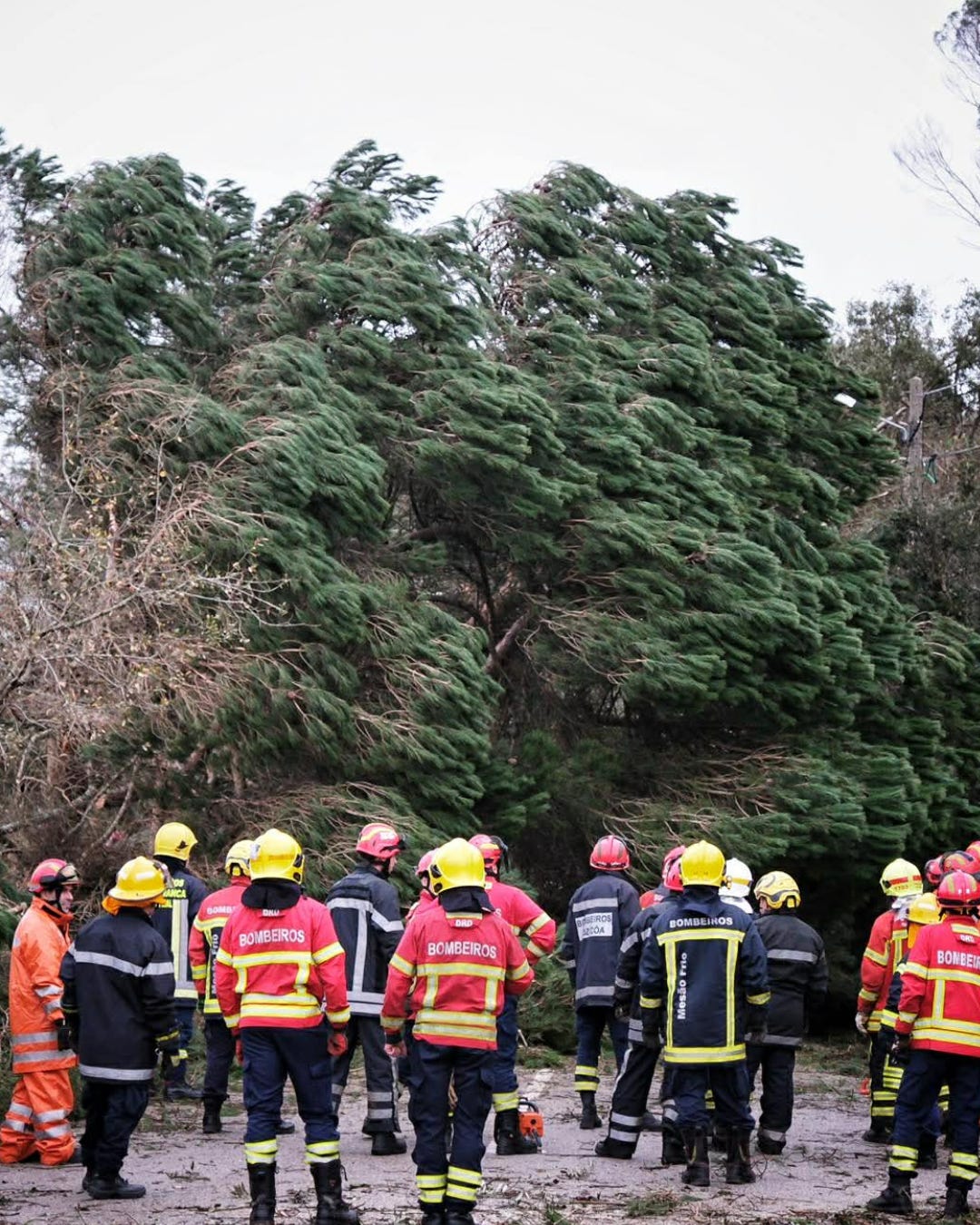
Destruction and Response
We do not immediately recognise the full extent of destruction. We feel the storm’s impact inside our homes, yet most of us lack the discernment to respond in that moment. Anguish mixes with the reports that begin to arrive, with glances cast toward neighbouring territories. Then silence descends. The absence of electricity, the lack of water, the collapse of communications that, after a week of hardship, still seem far from being restored.
Distances that already existed are amplified. The precarity of living outside central areas, however small those centers may be compared to the capital, is perceived in an entirely new way. This becomes evident in the time it takes to clear a road, to unblock a railway line, to restore energy supply. Preexisting support networks are put to the test, and the response emerges from within communities that knew they were alone but never imagined themselves abandoned.
Territorial politics are exposed at the moment of catastrophe. Thousands of theories, public and European investment programs, the smiles of politicians on the campaign trail, all lose their meaning overnight. In the end, there was nothing there that made us feel a sense of belonging.
The delayed response, the inability to mobilize existing resources and the demonstrated incapacity to connect with affected populations expose abandonment as a defining condition of being Portuguese. For days, the government remains silent and when it finally arrives on the ground, it becomes clear that it does not know how to speak. The convoluted metaphor of death uttered by the Prime Minister. The polished emptiness of the Minister of Internal Administration’s non-explanation. The brutal absence of empathy from the Minister of Territorial Cohesion.
Yet this is not merely the mediocrity of those currently in office. It is programmatic. It is embedded in a political logic we have big parties chosen to adopt, one that views the other as someone who does not require explanation, or even recognition. Catastrophe after catastrophe exposes how the country has been dismantled through privatisation and subcontracting, leaving us in a position where the public response, the response we always rely on when the market refuses to act, simply does not exist. And no market is interested in a situation that has not been rendered legible through budgeting planning.
At the same time, the media loses itself in live broadcasts that supposedly bring viewers to the scene, only for us to realize that the absence of reflection on what is being reported reduces events to small acts of spectacle. These add little to the urgent need to understand the storm as part of a country still being built.
Present Fatigue, Future Effect
The territory is struck by yet another depression and the land can no longer endure it. More floods, more landslides, more blocked roads, lives interrupted and distanced by power outages, disrupted water supplies and communications that collapse under the weight of fallen poles. We coexist in helplessness, wondering how long winter will last, this continuous disaster we cannot properly narrate because we are constantly running to address another leak, another obstruction, another improvised route home.
An inescapable emotional fatigue accumulates, trapping us in the labyrinth of not knowing what to do. This fatigue is shared by victims and helpers alike. At the same time, swarms of volunteer networks emerge, rushing to assist and forming lines of resistance against the apathy of institutional action. These efforts do not rely on insurance solutions, credit lines or government-funded plans, however comforting such proposals may be to economic commentators. Instead, they are grounded in the tangible demonstration that the State exists, that it has the capacity to act, to cooperate in response efforts and to lead the organisation of support for each individual and each community.
It is this shortening of distances that can produce a future effect for the country. From these networks, born precariously out of voluntary action, more solid forms of support and more meaningful political engagement emerge than from convoys of official vehicles offering “visibility” to catastrophe. As a revolutionary action plan, this may seem modest. But these are seeds planted when abstract organisation gives way to practice on the front line.
This reality is well understood by those in local governance, parishes and smaller municipal councils, who are forced to manage directly with their populations. The call for direct action fosters a deep connection to territory that large State institutions, operating at a distance, can scarcely achieve. Transforming this direct action into a political framework is not immediate. It is not a single reaction to a storm that generates a program. But the way we confront the existence of others, brutally, directly, empowers awareness of place, responsibility, and belonging.
Small steps still count. Ways of living that leave a mark. A way of building a country that is more alert, more present and better prepared for whatever storms may come.